Cookbook & organisation
Preserving family recipes before they disappear
4 min read
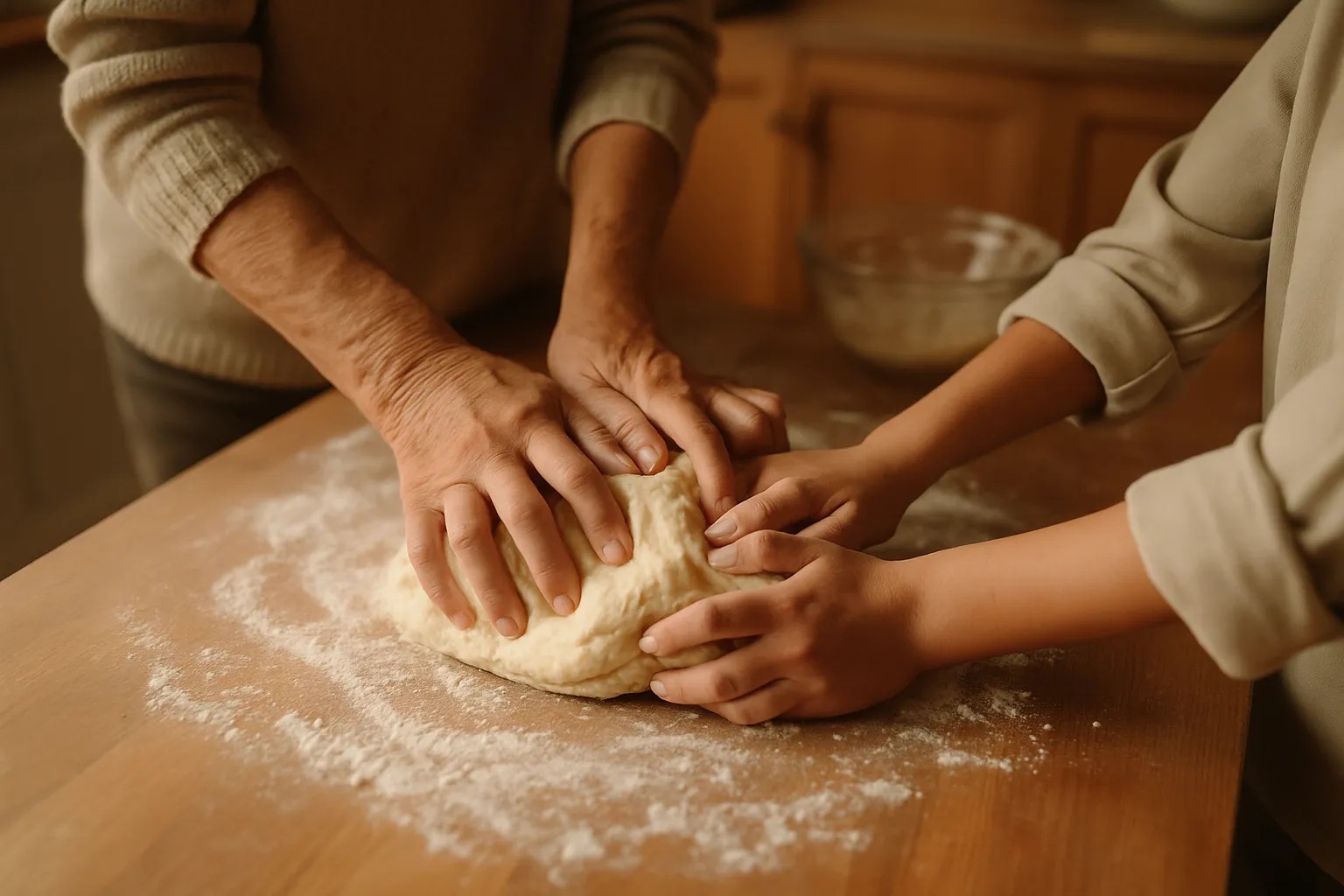
Almost every family has a few: dishes that belong to one person. Grandad's pea soup, your mother's Christmas roast, the butter cake your aunt is famous for. And almost every family discovers too late that such a recipe was never written down, or only as a list of ingredients without the knowledge that actually made the dish.
Capturing family recipes is not a nostalgic chore for someday. It is something best done while the cook in question is still standing next to you.
Why the written recipe is usually wrong
Ask your grandmother for her soup recipe and you get a list that is suspiciously short. "An onion, a carrot, a marrow bone, and then you just let it simmer." That list is not the recipe. The recipe lives in what she does not write down because she no longer recognises it as knowledge: that the onion sweats gently for ten minutes first, that she skims the foam twice, that the soup is only right after a night in the fridge.
Cooks who have made a dish for forty years measure with their hands and eyes. "A pinch" is an exact quantity to them, just not in grams. If you want to capture the recipe, do not ask for the recipe: ask for a cooking lesson.
Cook it together, once
The only reliable method: make the dish together and document while it happens. You touch nothing in the pan; you watch, ask and write. A few things to watch for specifically:
- Real-world quantities. See "a splash" of vinegar? Catch it in a spoon once before it goes in. Suddenly "a splash" is two tablespoons, and the recipe is reproducible.
- The moments when nothing seems to happen. "Let it bubble for a bit" turns out to be forty-five minutes. Put a timer next to it, not to correct, but to measure.
- The sensory checks. What does she look at before moving to the next step? "Until the dough no longer sticks", "until you smell the garlic": those are the instructions that make a recipe succeed.
- The deviations from the original. Many family recipes started life in a book and were rebuilt over thirty years. That rebuild is exactly what you want on record.
Photograph the in-between stages, or film loosely on your phone. Not for posterity, but because when writing it up you will want to check how coarsely the vegetables were cut and how brown "golden brown" really was.
Write it up like a real recipe
Back home, turn your notes into a recipe someone else could cook: ingredients with quantities, steps in order, times included. Write the sensory checks straight into the steps; "stir until the sauce coats the back of a spoon" is a perfectly good cooking instruction.
Then store it somewhere that will outlive a kitchen drawer. One paper copy is exactly the fragility you were trying to escape. Digital has an extra advantage here: you share the recipe with the whole family in one go, and when your nephew puts his own spin on it next year, that version can live alongside the original instead of on top of it. If you keep your recipes in an app like Recettino, you can have a photographed handwritten page converted directly into a structured recipe, which saves a lot of retyping.
Finally, record the provenance inside the recipe itself: whose it is, how long it has been in the family, and on which occasions it appeared on the table. Twenty years from now that context is worth at least as much as the ingredient list.
It is never too early
The reason so many family recipes vanish is not unwillingness but postponement. It feels awkward to say "I want to record your recipes while it is still possible". So flip it: ask for a cooking afternoon because you want to learn the dish yourself. That is what it genuinely is, and it happens to be one of the nicer ways to spend an afternoon with your mother, father or grandmother.
One dish at a time is enough. A family cookbook is not built in a weekend; it grows soup by soup, cake by cake, Christmas by Christmas. Start with the dish you would miss the most.